Showing posts with label Author Notes. Show all posts

Friday, January 20, 2023

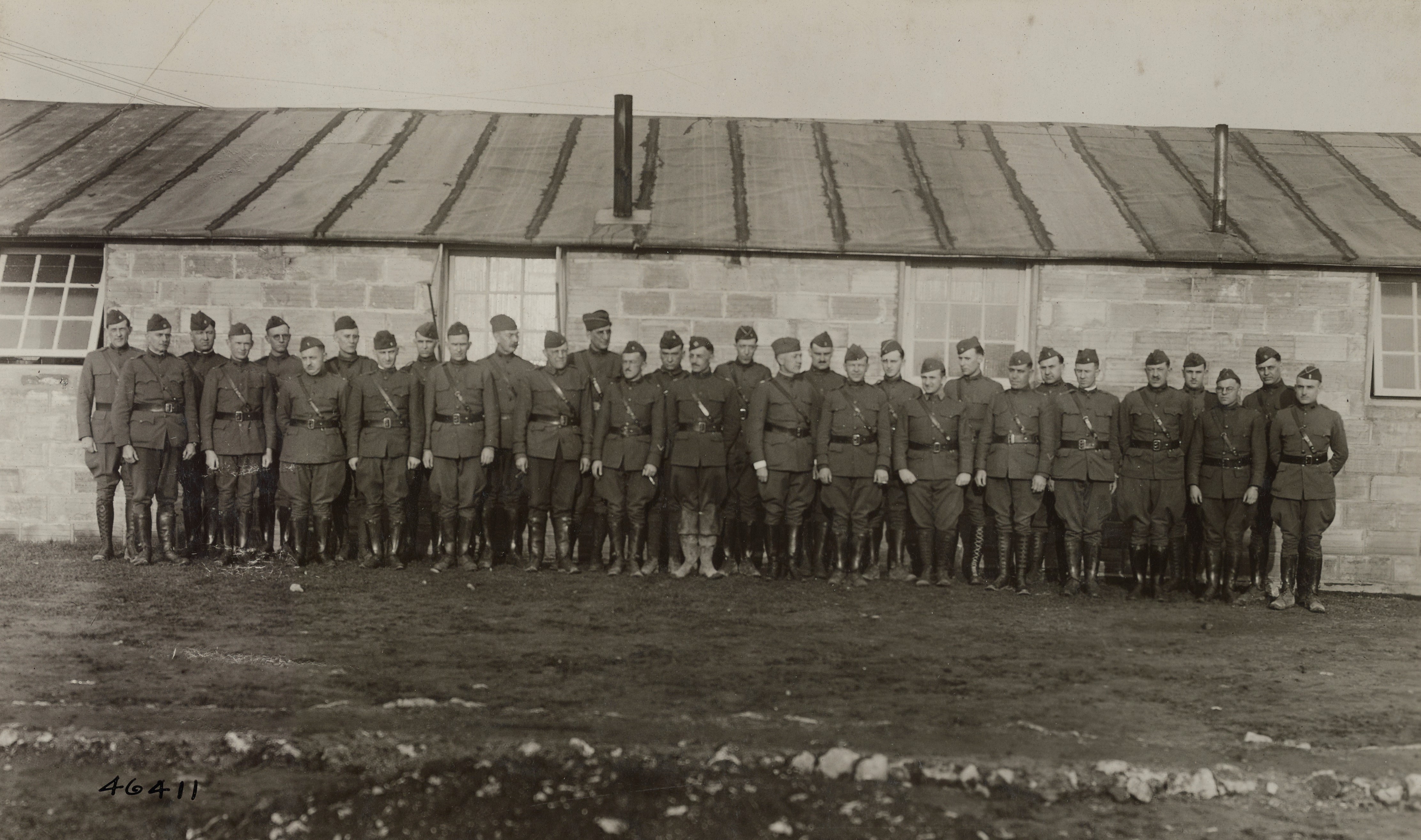
Officers of Base Hospital 50


Officers of Base Hospital No. 50

Mesves, Nievre, France, 19 January 1919.

The United States National Archives and Records Administration (NARA) has been digitizing photos in its collections taken by the U.S. Army Signal Corps during World War I and adding records to its Archival Research Catalog (ARC). 

This photograph of the officers of Base Hospital 50 was taken the day after Major James Eagleson received orders the unit was to disband. A memorial service was held to honor the five members who died while the unit served in France: Charles Fletcher, Dr. William Kanter, Edward Nesser, Samuel Parker, and William White. Chaplains Hansen Bergen and Fr. William Carroll C. SS. R., addressed the unit in the Recreation Hall, along with Major Eagleson. The following day, January 20, 1919, Base Hospital 50 ceased operations and all of its remaining patients were turned over to Base Hospital 54. 

Front row. Left to right:
Major J. A. Hawkins; Lt. K. Vaughn; Lt. J. R. Carothers; Lt. H. F. Garmain; Lt. H. C. Randolph; Capt. E. O. Jones; Lt. H. B. Thompson; Capt. Copeland Plummer; Capt. A. J. Helton; Major H. E. Allen; Lt. L. Savitsky; Lt. J. Denno; Lt. H. J. Knott; Major F. A. Black; Lt. A. K. Stebbing; Lt. A. F. Mattice. 

Rear row. 
Capt. F. T. Wilt; Capt. Robert Hamilton; Lt. E. L. Wilkins; Chaplain W. M. Carroll; Lt. G. A. Braun; Major J. B. Eagleson; Major E. P. Fick; Capt. T. F. Shinnick; Lt. W. W. Schmidt; Lt. G. L. Curran; Lt. H. T. Buckner; Capt. W. E. Lowrie; Lt. J. J. Szmanski; Lt. J. A. Lybecker; Major N. A. Cary.

Photo credit:  Officers of Base Hospital No. 50.. Photograph 86698995, local identifier 111-SC-46411.  (catalog.archives.gov/id/86698995 : accessed 20 January 2023.)


Monday, October 15, 2018

Josephine H - Researching Those Who Served

Irish US Army nurse’s World War I bracelet
returned after worldwide hunt
I recently returned from a wonderful tour, Across Two Wars, sponsored by the National WWII Museum in New Orleans. One of the things the tour reinforced for me is it is the stories of individuals which I find to be the most compelling. Charts and numbers about artillery and bombs are all very interesting but the people behind those facts are what really bring the events to life for me.

One such story I came across last week, which has nothing to do with Base Hospital 50, but has everything to do with what motivated me to start this blog in the first place, documents the untold story about one of those who served in World War I. The documentary uncovering the story of Josephine H is exactly the sort of story which inspires and fuels me to continue telling stories myself.

In a nutshell, years ago an 8-year-old student in France came across a bracelet in the schoolyard engraved with "Josephine Heffernan, ABH 59, US ANC". He gave it to his teacher, Estelle Lefeuvre and she promised to find out more about its owner. As so often happens, good intentions to look into the history of the bracelet were derailed by other things and it wasn't until she retired more than a decade later that the bracelet resurfaced and Estelle began to pursue its history.

The United States had an Army hospital at Rimacourt during World War I and the initial theory was Heffernan was an Army nurse there. An international nurse historian, Marjorie DesRosier helped confirm that theory and uncover more details about Josephine, her wartime service and what became of her after the war.

Josephine Heffernan, a native of Ireland, immigrated to the United States in 1906 and attended nursing school. She enlisted to serve during World War I and was deployed to the base hospital in Rimaucourt, France. At some point, her bracelet was lost leading to a historical forensic chase to learn about her life a century later. What a wonderful story combining history, expertise, and luck, all sparked by a curious, and observant, little boy!

Monday, April 17, 2017

Army Transport Passenger Lists

Physicians of Base Hospital 50 sailing on the SS Karmala for France.

In honor of the 100th anniversary of the United States' entry in the World War I, Ancestry recently released an important new database, U.S., Army Transport Service, Passenger Lists, 1910-1939. A devastating fire in 1973 at the National Personnel Records Center  a branch of the National Archives located in St. Louis – destroyed an estimated 80% of Army personnel records. WWI draft registration cards do not provide proof of service and these troop passenger manifests help fill an important gap.

The collection includes 8.4 million records from the Army Transport Service (ATS). The ATS was established in 1899 as part of the Army Quartermaster Department. It was originally created to manage the transport of troops and cargo on Army ships that traveled between U.S. and overseas ports during the Spanish-American War. 

The ATS passenger lists document the movement of troops traveling to and from foreign ports. Civilian support personnel, such as nurses, and family members, war brides for example, may also be listed. The manifests also include deceased US soldiers whose remains were repatriated; invaluable information because this didn't happen until several years after the war ended.

Details recorded in these passenger lists typically include:
  • Ship name 
  • Arrival date and place 
  • Departure date and place 
  • Service member's name, rank, service number, age, residence, next of kin with relationship, and the regiment, company, detachment, or other organization that the service member was attached to.
For non-service members, entries also include their relation to a service member.